
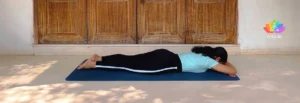
- Lie face down with legs together, tops of the feet on the mat.
- Place your palms flat beside the lower ribs, fingers pointing forward.
- Draw your elbows in toward your body and keep them close.
- Press the tops of your feet, thighs and pubic bone into the floor.
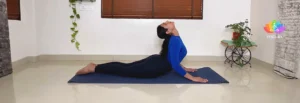
- Inhale and slowly lift your head and chest off the mat.
- Straighten your arms only as far as the pelvis stays grounded.
- Roll your shoulders back and down, away from the ears.
- Look forward with a long neck; keep the gaze soft.
- Hold for three to five steady breaths.
- Exhale and lower the chest, then the forehead, back to the mat.
Bhujangasana (Bhujangasana (Cobra Pose) )
Sanskrit: भुजङ्गासन · Pronunciation: boo-jang-GAHS-anna · Chakras: Manipura, Anahata
This page explains bhujangasana, the Cobra Pose, for learners searching how to practise it correctly and safely. You will find clear steps, alignment cues, common mistakes, benefits, variations, props and safety guidance. It suits beginners and regular practitioners who want a clear, practical, teacher-led guide to this foundational yoga backbend.
Overview
What Is Bhujangasana?
Bhujangasana, or Cobra Pose, is a foundational yoga backbend in which you lie on your stomach and lift your chest by pressing your palms into the floor, like a rising cobra. It strengthens the back muscles, arms and shoulders, opens the chest and abdomen, and encourages a supple spine. A staple of Surya Namaskar, it is also a gentle, accessible way to learn backbending with control.
Sanskrit Name
Bhujangasana (भुजङ्गासन)
Meaning
Cobra Pose
Pose Type
Prone Backbend
Strengthens
Back, Arms, Shoulders
Also Known As
Cobra Pose, Snake Pose
Chakras Activated
Manipura, Anahata
Stretches
Chest, abdomen, shoulders, spine
Pronunciation
boo-jang-GAHS-anna
Warm Up First
Preparatory Poses
Step by Step
How to Do Bhujangasana — Step-by-Step Instructions
Alignment Cues
Key Alignment Cues
- Keep the hands under the shoulders with fingers spread wide.
- Hug the elbows in, pointing back toward the heels.
- Lift the chest forward and up, not just the head.
- Draw the shoulder blades down and together.
- Keep the legs together, firm and active.
- Let the back muscles lift you, not the arms alone.
- Lengthen the tailbone toward the heels.
- Keep the neck in line with the spine.
Watch Out
Common Mistakes
Over-Lifting
Lift only to where the pelvis stays down and the back feels long.
Shoulders Near Ears
Roll the shoulders back and down to open the chest.
Crunching the Lower Back
Engage legs and glutes, and lengthen the tailbone toward the heels.
Pushing with Arms Alone
Use the back muscles to lift; keep the elbows slightly bent.
Flared Elbows
Hug the elbows in toward the ribs and point them to the heels.
Throwing the Head Back
Keep the neck long and the gaze forward.
Benefits
Benefits of Bhujangasana
Strength
- Strengthens the spine and back
- Tones the arms and shoulders
- Engages the glutes and legs
Flexibility
- Opens the chest and lungs
- Stretches the abdomen
- Improves spinal flexibility
Posture
- Counters hunched, desk-bound posture
- Builds upper-back awareness
Mind and Energy
- Energises the body
- Eases mild stress and fatigue
Variations
Bhujangasana Variations to Consider
Sphinx Pose Rest on the forearms for a gentler, lower-back-friendly lift.
Baby Cobra Lift the chest with arms bent and the navel grounded.
Full Cobra Straighten the arms while keeping the pelvis firmly down.
Twisting Cobra Turn the head toward one heel to add a gentle spinal twist.
Hands-Off Cobra Hover the palms to challenge the back muscles directly.
After the Pose
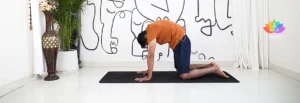
Counter Poses for Bhujangasana (Cobra Pose)
Always neutralise the spine after any backbend. Practice one or two of these counter poses immediately after Bhujangasana (Cobra Pose) :
Balasana (Child’s Pose)
Balasana (Child’s Pose) gently releases the back after the backbend.
Avoid If
Who Should Avoid This Pose
- Pregnancy, especially after the first trimester
- Recent abdominal surgery or hernia
- Acute lower-back injury or slipped disc
- Carpal tunnel syndrome or painful wrists
- Recent neck or shoulder injury
- Severe headache or active migraine
Therapeutic Uses
Ailments That May Benefit from Bhujangasana (Cobra Pose)
- May ease mild stiffness and tightness in the back.
- Traditionally used to improve posture from long sitting.
- Traditionally suggested for sluggish digestion; evidence is limited.
- Traditionally used to ease fatigue and mild stress.
- Opens the chest and may support deeper breathing.
- Not a treatment for sciatica or asthma; consult a doctor.
FAQ
Frequently Asked Questions
What is bhujangasana?
A foundational prone yoga backbend, also called Cobra Pose, that lifts and opens the chest.
How long should I hold Cobra Pose?
Hold for three to five breaths; repeat two to three rounds as comfortable.
What is the difference between Cobra and Upward Dog?
In Cobra the thighs stay down; in Upward Dog they lift and the arms are straight.
Should my arms be straight in Cobra Pose?
Not necessarily. Keep a slight bend so the back muscles, not the arms, do the lifting.
What are the benefits of Cobra Pose?
It strengthens the back, opens the chest, stretches the abdomen and improves posture.
Why does my lower back hurt in Cobra Pose?
Usually from lifting too high. Lower down, engage the legs and lengthen the tailbone.
Can beginners do bhujangasana?
Yes. Start with Sphinx Pose or Baby Cobra and build height gradually.
Who should avoid Cobra Pose?
Avoid in pregnancy, after abdominal surgery, or with acute back, wrist or neck injury.