



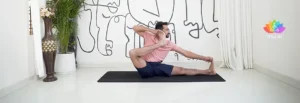
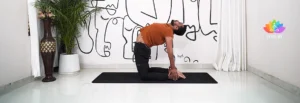
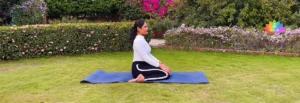
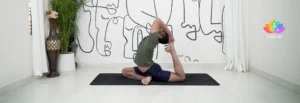

- Stand in Tadasana. Ground all four corners of both feet firmly into the mat.
- Shift your weight to the left foot. Press it evenly — do not roll inward.
- Bend the right knee; draw the right heel toward the right buttock.
- Reach the right arm back; hold the inner arch of the right foot firmly
- On an inhale, lengthen the spine fully and lift the sternum upward.
- On an exhale, kick the right foot into the hand to begin lifting the leg.
- Tip the torso forward — keep the hips square and parallel to the floor.
- Extend the left arm forward, parallel to the floor, fingers pointing ahead.
- Press the foot firmly into the hand to deepen the backbend gradually
- Fix the gaze (drishti) on a steady point on the floor before lifting.
- Hold for 5 to 10 breaths. Keep the breath slow, steady, and full.
- To exit, lower the right leg slowly on an exhale. Return to Tadasana.
- Rest for 2–3 breaths. Repeat the full sequence on the left side equally.
Natarajasana (Natarajasana – Lord of the Dance Pose)
Sanskrit: नटराजासन · Pronunciation: nah-tuh-RAH-jah-SAH-nuh ·
🧘 Intermediate
🔁 Balance, Backbend
⭐ Anahata, Ajna
⏱ 15–90 sec
🌅 Morning / Evening
This page is your complete guide to Natarajasana (Lord of the Dance Pose) — the standing backbend dedicated to Lord Shiva as the cosmic dancer. Learn correct technique, step-by-step entry, precise alignment cues, variations from beginner to Baddha Natarajasana, therapeutic benefits, and clear contraindications for this iconic balancing backbend.
Overview
What Is Natarajasana?
Natarajasana is an intermediate standing backbend and one-legged balance dedicated to Shiva — the cosmic dancer, Nataraja. Balancing on one leg, the practitioner bends the opposite knee, grasps the foot, and lifts it skyward while tipping the torso forward into a soaring arc. The pose builds spinal strength, opens the chest and hip flexors, and demands total one-pointed concentration — the physical embodiment of grace, balance, and inner stillness.
Sanskrit Name
Natarajasana (नटराजासन)
Meaning
Dancer King
Pose Type
Standing Balance, Backbend
Strengthens
Legs, Core, Shoulders
Also Known As
Dancer Pose, King Dancer Pose
Chakras Activated
Anahata, Ajna, Manipura
Stretches
Chest, Shoulders, Hip Flexors, Quads
Pronunciation
not-ah-raj-AHS-ah-nah
Warm Up First
Preparatory Poses
Step by Step
How to Do Natarajasana — Step-by-Step Instructions
Alignment Cues
Key Alignment Cues
- Standing foot: press evenly through all four corners — no inward rolling.
- Standing knee: micro-bend maintained throughout — quad fully engaged.
- Hips stay square to the front — the lifted-side hip must not open outward.
- Tailbone lengthens down before the leg lifts — this protects the lumbar spine.
- Chest lifts and opens against the forward tilt — sternum draws up actively.
- Shoulder blades draw toward each other — the front chest broadens fully.
- The grasping arm is straight and active — a bent elbow loses all leverage.
- Forward arm is parallel to the floor — not drooping or raised too high.
- Drishti is fixed before the lift — the gaze does not move during the hold.
- Breath stays slow and diaphragmatic — breath-holding signals you are at your limit.
Watch Out
Common Mistakes
Hip opens outward
Rotate inner thigh inward to square both hips forward.
Standing knee locked
Keep a micro-bend to protect the knee joint fully.
Lower back crunches
Lengthen tailbone down before kicking the leg upward.
Grasping arm bends
Straighten the arm — a bent elbow loses all leverage.
Chest collapses
Lift the sternum actively against the forward body tilt.
Kicking with force
Use slow muscle control, not momentum, to raise the leg.
Gaze wandering
Fix your drishti first — a moving eye breaks balance fast.
Breath is held
Breath-holding signals the pose is past your current edge.
Benefits
Benefits of Natarajasana
Balance & Stability
- Improves single-leg balance
- Trains proprioception
- Builds ankle stability
- Sharpens mental focus
Strength
- Tones standing-leg muscles
- Strengthens glutes
- Builds shoulder strength
- Engages deep core muscles
Flexibility
- Opens chest and heart space
- Stretches hip flexors deeply
- Lengthens the quadriceps
- Loosens front shoulders
Mind & Energy
- Activates Anahata Chakra
- Stimulates Ajna (Third Eye)
- Builds confidence and poise
- Reduces stress and anxiety
Therapeutic (Traditional)
- Aids weight management
- Stimulates thyroid gland
- Supports PCOD/PCOS care
- Improves immune function
Posture & Spine
- Counters kyphosis
- Strengthens erector spinae
- Improves spinal mobility
- Trains upright body posture
Variations
Natarajasana Variations to Consider
Natarajasana with Strap Loop strap around foot — bridges the reach gap safely.
Wall-Supported Fingertips on wall — teaches balance safely for beginners.
Both-Hands Natarajasana Both hands grasp the foot — deepens the spinal arch.
Baddha Natarajasana Full overhead bind — advanced; requires deep flexibility.
Chair-Supported Hold a chair back — makes the pose accessible to seniors.
Eka Pada Rajakapotasana Related deep hip and spine opener — advanced progression.
After the Pose
Counter Poses for Natarajasana – Lord of the Dance Pose
Always neutralise the spine after any backbend. Practice one or two of these counter poses immediately after Natarajasana – Lord of the Dance Pose:
Uttanapadasana — Raised Leg Pose
Releases hip flexors and the standing-leg hamstrings.
Balasana (Child’s Pose)
Gently neutralises the spinal backbend extension fully.
Supta Matsyendrasana (Supine Spinal Twist Pose)
Releases lower back after one-sided loading.
Avoid If
Who Should Avoid This Pose
- Acute knee injury or ligament damage — standing knee bears full load.
- Ankle injury or instability — single-leg balance stresses the ankle.
- Lower back injury or acute disc herniation — backbend load is high.
- Shoulder injury or rotator cuff damage — the arm hold creates stress.
- Vertigo, dizziness, or balance disorders — fall risk is significant.
- Low blood pressure (uncontrolled) — forward tilt can cause fainting.
- High blood pressure (uncontrolled) — sustained exertion spikes BP.
- Pregnancy — balance risk and abdominal pressure are contraindicated.
- Severe osteoporosis — fall risk and bone-stress are both elevated.
Therapeutic Uses
Ailments That May Benefit from Natarajasana – Lord of the Dance Pose
- Mild postural kyphosis — chest opening and spinal extension counter forward rounding.
- Mild anxiety and stress — Anahata activation and focused balance calm the nervous system.
- Weak ankles — progressive single-leg weight-bearing gradually builds ankle strength.
- Poor concentration — the pose demands and systematically trains one-pointed focus.
- Mild thyroid imbalance — neck extension improves thyroid blood flow (traditional claim).
- PCOD/PCOS management — hip opening and pelvic circulation are supportive (adjunct only).
- Weight management — full-body heat and activation support metabolism (adjunct only).
FAQ
Frequently Asked Questions
What is Natarajasana?
A one-legged standing backbend dedicated to Shiva as the cosmic dancer. It blends balance, backbend, and hip opening in one graceful shape.
Who can practise Natarajasana?
Intermediate students with stable single-leg balance, open hip flexors, and no active knee, shoulder, or lower back injuries.
How long should I hold Natarajasana?
Hold 5–10 breaths per side. Build gradually over weeks. Always practise both sides equally to prevent muscular imbalance.
Which chakra does Natarajasana activate?
Primarily Anahata (Heart) through chest opening. Also Ajna (Third Eye) via concentration and Manipura (Solar Plexus) via core engagement.
Can a beginner do Natarajasana?
Yes — with a strap and wall support. First master Tadasana, Tree Pose, and Virabhadrasana III, then approach the full expression.
Why do I keep losing balance in Natarajasana?
A wandering gaze is the top cause. Fix your drishti before lifting the leg and hold the gaze steady throughout the entire hold.
What is Baddha Natarajasana?
The bound version — both hands reach overhead to grasp the foot. It is advanced and requires deep flexibility throughout the whole body.
Is Natarajasana good for weight loss?
It builds heat, activates the full posterior chain, and stimulates the thyroid — beneficial as part of a balanced practice.