
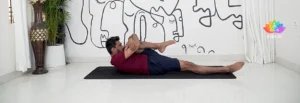
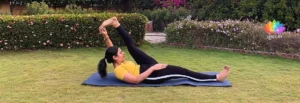
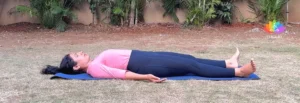
- Lie on your back with legs together, arms by your sides and palms down.
- Press the lower back into the mat and draw the navel gently in.
- Inhale and lift both straight legs to about 45 degrees.
- Keep the knees straight and the toes pointing toward the ceiling.
- If the back stays flat, continue to 60, then 90 degrees.
- Keep the shoulders, hips and head resting on the floor.
- Hold for 5 seconds, building toward 30 seconds with practice.
- Exhale and lower the legs slowly, without letting the back arch.
- Rest in Savasana, then repeat for 3 to 4 rounds.
Uttanapadasana (Uttanapadasana — Raised Leg Pose )
Sanskrit: उत्तानपादासन · Pronunciation: oo-tah-nah-pah-DAH-sah-nah · Chakras: Manipura
This page serves people searching for uttanapadasana who want to know what the pose is, how to lift the legs safely and what it does for the core. Intent is informational, at the awareness-to-consideration stage. Readers should leave knowing the correct steps, hold time, benefits, mistakes, variations and who should avoid it.
Overview
What Is Uttanapadasana?
Uttanapadasana, or Raised Leg Pose, is a supine asana in which you lie on your back and lift both straight legs to about 45 or 90 degrees while the back stays on the floor. The name joins uttana, meaning raised or stretched, pada, meaning leg, and asana, meaning posture. It strengthens the lower abdomen and hip flexors and stretches the hamstrings. It suits beginners.
Sanskrit Name
Uttanapadasana (उत्तानपादासन)
Meaning
Raised Leg
Pose Type
Supine Leg Raise, Core Strengthener
Strengthens
Core, hip flexors
Also Known As
Raised Leg Pose, Leg Raising Pose
Chakras Activated
Manipura
Stretches
Hamstrings, calves, lower back
Pronunciation
oo-tah-nah-pah-DAH-sah-nah
Warm Up First
Preparatory Poses
Step by Step
How to Do Uttanapadasana — Step-by-Step Instructions
Alignment Cues
Key Alignment Cues
- Keep the lower back in light contact with the floor throughout.
- Line the legs and feet together, knees fully extended.
- Keep the thighs active and the toes pointing upward.
- Draw the lower belly in to protect the lumbar spine.
- Rest the shoulders, neck and jaw; keep the head down.
- Let the arms stay long with the palms pressing down.
- Lower the legs at the same pace as you lifted them.
Watch Out
Common Mistakes
Bending the knees
Straighten the legs; bend only to protect the back.
Arching the lower back
Press the back down and lower the legs a little.
Lifting the hips
Keep the hips grounded and lift only from the core.
Dropping the legs fast
Lower slowly to keep the abdomen engaged.
Straining head and neck
Keep the head down and the shoulders relaxed.
Forcing 90 degrees
Stop at the height where the back stays flat.
Benefits
Benefits of Uttanapadasana
Core & Abdomen
- Strengthens the lower abdomen
- Tones the pelvic floor
- Builds core stability
Legs & Hips
- Stretches hamstrings and calves
- Strengthens hip flexors
- Tones the thighs
Spine & Posture
- Supports a stable lower back
- Encourages better posture
Digestion & Calm
- May ease gas and constipation
- May calm the mind
Variations
Uttanapadasana Variations to Consider
Ardha Uttanapadasana (Single Leg) One leg lifts at a time while the other stays grounded.
Dwi Pada Uttanapadasana (Both Legs) Both legs lift together to 45, 60 or 90 degrees.
Bent-Knee Uttanapadasana Knees stay bent to protect the lower back.
Uttanapadasana with Stool Calves rest on a stool for a restful, supported hold.
After the Pose
Counter Poses for Uttanapadasana — Raised Leg Pose
Always neutralise the spine after any backbend. Practice one or two of these counter poses immediately after Uttanapadasana — Raised Leg Pose :
Anantasana (Sleeping Vishnu Pose)
Hug the knees into the chest in Apanasana to release the lower back.
Avoid If
Who Should Avoid This Pose
- Hernia, including after hernia repair
- Recent abdominal, hip or spinal surgery
- Slipped disc, spondylitis or severe back pain
- Pregnancy; avoid or use only prenatal guidance
- Menstruation; practise only with a teacher's guidance
- Heart disease or high blood pressure
- Peptic ulcer or migraine
- Hip replacement, unless your doctor approves
Therapeutic Uses
Ailments That May Benefit from Uttanapadasana — Raised Leg Pose
- Weak abdominal muscles: strengthens the lower belly and core.
- Mild lower back stiffness: a stronger core may help; avoid with acute pain.
- Gas and constipation: a traditional claim with limited evidence.
- Indigestion and acidity: a traditional claim; not a substitute for care.
- Swollen leg veins: raising the legs may aid blood return; evidence is limited.
- Stress and tension: a calming effect is reported, mainly from steady breathing.
FAQ
Frequently Asked Questions
What is Uttanapadasana?
A supine pose where both straight legs lift to 45 or 90 degrees, working the core and hip flexors.
What does Uttanapadasana mean?
Uttana means raised, pada means leg and asana means posture: the Raised Leg Pose.
How long should you hold Uttanapadasana?
Start with 5 seconds and build toward 30 seconds. Repeat for 3 to 4 rounds.
Is Uttanapadasana good for lower back pain?
A stronger core may ease mild stiffness. Bend your knees if the back arches; skip it in acute pain.
Does Uttanapadasana reduce belly fat?
It tones the lower abdomen, but yoga alone does not remove belly fat. Pair it with diet and activity.
Can you do Uttanapadasana during pregnancy?
Avoid it in pregnancy. Ask your doctor or a prenatal teacher about safer core work.
How is it different from Uttanasana?
Uttanapadasana is a supine leg raise; Uttanasana is a standing forward fold.
When is the best time to practise it?
Morning on an empty stomach, or at least three hours after a meal.