
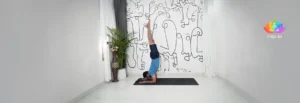
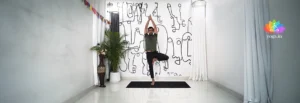
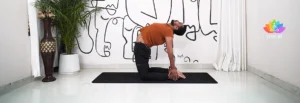
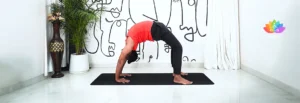
- Kneel on the mat. Place forearms flat on the floor, elbows shoulder-width apart.
- Interlace fingers or keep palms flat. Press evenly through the entire forearm.
- Tuck toes, lift knees, and walk feet in toward elbows — this is Dolphin Pose.
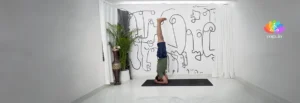
- On an exhale, kick or walk both legs up into Pincha Mayurasana (Forearm Stand).
- Pause in Pincha Mayurasana at the wall. Take 3 to 5 slow, steady breaths.
- On an inhale, begin bending both knees toward the head simultaneously.
- Press actively through both forearms to maintain shoulder lift and spinal length.
- Continue arching the back — chest presses forward through the shoulders.
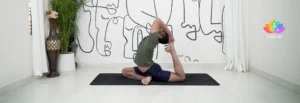
- Lower the feet gradually toward the crown of the head to find the Scorpion shape.
- Lift the head upward and forward — gaze is directed ahead, not toward the floor.
- Hold for 5 to 15 breaths with slow, controlled diaphragmatic breathing throughout.
- To exit: slowly straighten the knees back to Pincha Mayurasana.
- Lower one leg, then the other, to the floor. Rest in Balasana immediately.
Vrischikasana (Vrischikasana — Scorpion Pose )
Sanskrit: वृश्चिकासन · Pronunciation: vrish-chee-KAH-sah-nah · Chakras: Sahasrara, Ajna, Anahata
This page is your complete guide to Vrischikasana (Scorpion Pose) — one of yoga’s most visually iconic advanced inversions. Learn both classical forms (Vrischikasana I and II), safe step-by-step entry from Pincha Mayurasana, critical alignment cues, preparatory prerequisites, all major variations, extensive benefits for the brain and spine, and who must never attempt this pose.
Overview
What Is Vrischikasana?
Vrischikasana — the Scorpion Pose — is an expert-level inverted backbend in which the practitioner balances on the forearms, arches the spine dramatically, and curls the legs overhead until the feet descend toward the crown of the head, replicating a scorpion poised to strike. It combines Pincha Mayurasana (Forearm Stand) with a deep Chakrasana-like backbend in a single suspended expression — demanding exceptional spinal flexibility, shoulder strength, and complete inversion control.
Warm Up First
Preparatory Poses
Step by Step
How to Do Vrischikasana — Step-by-Step Instructions
Alignment Cues
Key Alignment Cues
- Elbows stay exactly shoulder-width apart — splayed elbows collapse the base.
- Forearms press evenly and actively into the mat — no passive resting.
- Shoulders lift away from the ears throughout — no shrugging into the neck.
- Chest presses forward through the arms — not collapsing between the shoulders.
- Spine arches from the thoracic region — the lumbar must not over-compress.
- Inner thighs rotate toward each other — prevents the legs from splaying wide.
- Knees bend symmetrically — one knee dropping lower shifts the balance instantly.
- Head lifts upward, gaze is forward — do not drop the head toward the floor.
- Core is lightly engaged throughout — bracing too hard restricts the arch.
- Breath stays free and diaphragmatic — if breath stops, exit with control.
Watch Out
Common Mistakes
Elbows splaying wide
Use a strap above the elbows to hold shoulder-width apart.
Collapsing into shoulders
Press forearms actively — the shoulder lift is continuous.
Forcing feet to the head
Let the arch open over months — forcing injures the spine.
Dropping the head down
Lift the head and gaze forward — do not look at the floor.
Over-compressing lumbar
Arc from the thoracic spine; draw the lower belly in lightly.
Holding the breath
Breath-holding signals you have passed your current edge.
Benefits
Benefits of Vrischikasana
Brain & Endocrine
- Increases blood flow to brain
- Stimulates pituitary gland
- Activates pineal gland
- Improves memory and focus
Strength
- Builds forearm and wrist strength
- Tones shoulders and deltoids
- Strengthens deep core muscles
- Builds spinal extensor strength
Flexibility & Spine
- Deepens thoracic backbend
- Opens hip flexors fully
- Stretches the entire abdomen
- Loosens chest and front body
Circulation
- Reverses venous pooling in legs
- Improves pelvic circulation
- Tones reproductive organs
- Drains lymph from lower limbs
Mind & Energy
- Activates Sahasrara Chakra
- Stimulates Ajna (Third Eye)
- Opens Anahata (Heart) Chakra
- Builds mental fearlessness
Anti-Aging (Traditional)
- Arrests physical aging process
- Revitalises all body systems
- Balances endocrine function
- Boosts overall body vitality
Variations
Vrischikasana Variations to Consider
Wall-Assisted Vrischikasana Feet rest on wall — safe entry point for all learners.
Vrischikasana I (Forearm) Classical form — forearm balance with feet to head.
Vrischikasana II (Handstand) Iyengar's advanced form — full handstand base; very hard.
Sirsasana Scorpion Headstand base — legs arch overhead into the scorpion shape.
Sole-to-Head Variation Flat soles rest on crown — deepest spinal arch possible.
Shalabha Vrischikasana Prone version — legs lift from floor into scorpion shape.
After the Pose
Counter Poses for Vrischikasana — Scorpion Pose
Always neutralise the spine after any backbend. Practice one or two of these counter poses immediately after Vrischikasana — Scorpion Pose :
Balasana (Child’s Pose)
Taken immediately after exit; releases neck and lower back.
Paschimottanasana (Seated Forward Bend)
Forward fold neutralises the deep spinal backbend.
Supta Matsyendrasana (Supine Spinal Twist Pose)
Supine twist decompresses the lumbar and sacrum.
Avoid If
Who Should Avoid This Pose
- Beginners — this pose requires years of consistent inversion preparation.
- High blood pressure (uncontrolled) — inversion spikes cerebral pressure.
- Heart conditions — the exertion and inversion place high cardiac demand.
- Glaucoma — intraocular pressure increases significantly in full inversions.
- Cervical disc herniation or neck injury — neck bears indirect load.
- Acute lower back injury or disc prolapse — extreme backbend is dangerous.
- Shoulder or rotator cuff injury — full body weight is on the shoulders.
- Wrist or elbow injury — forearms bear the full body-weight load.
- Vertigo or inner ear disorders — inversion will worsen symptoms severely.
- Brain-related conditions — any cerebral pathology is an absolute contraindication.
- Menstruation and pregnancy — inversion and abdominal pressure contraindicated.
Therapeutic Uses
Ailments That May Benefit from Vrischikasana — Scorpion Pose
- Postural kyphosis — thoracic extension directly counters forward spinal rounding.
- Poor concentration and mental fatigue — cerebral blood flow boost improves focus.
- Mild depression and low energy — inversion and Sahasrara activation uplift mood.
- Mild reproductive system disorders — pelvic circulation improved via inversion (traditional claim; adjunct only).
- Weak shoulders and forearms — progressive load-bearing builds joint resilience over time.
- Chronic lethargy — the full-body activation and endocrine stimulation revitalise the system.
- Mild sinusitis — gravitational drainage reversal clears the nasal passages (traditional claim).
FAQ
Frequently Asked Questions
What is Vrischikasana?
An expert-level inverted backbend. The practitioner balances on forearms, arches the back, and curls feet toward the head like a scorpion’s tail.
What are the two forms of Vrischikasana?
Vrischikasana I uses a forearm balance base. Vrischikasana II uses a full handstand base — described by Iyengar as extremely difficult.
What must I master before attempting Vrischikasana?
Pincha Mayurasana (Forearm Stand) must be stable and held for 1–2 minutes. Chakrasana and Ustrasana flexibility are also essential prerequisites.
Which chakras does Vrischikasana activate?
Sahasrara (Crown) and Ajna (Third Eye) through the inversion. Anahata (Heart) through the deep chest-opening backbend. Vishuddha via the neck.
How long should I hold Vrischikasana?
Beginners: 5 breaths. Intermediate: 10–15 breaths. Advanced: up to 30 seconds. Always exit before fatigue forces an uncontrolled descent.
Is Vrischikasana the same as Pincha Mayurasana?
No. Pincha Mayurasana is a forearm stand with legs straight. Vrischikasana adds a deep backbend, bending knees to bring feet toward the head.
Can Vrischikasana slow ageing?
Traditional texts claim it arrests ageing by improving pituitary and pineal function. It is best viewed as supportive alongside a full yoga practice.
What is the best counter-pose after Vrischikasana?
Balasana (Child’s Pose) immediately after exit. Follow with Paschimottanasana to neutralise the spinal backbend and release the lumbar completely.