
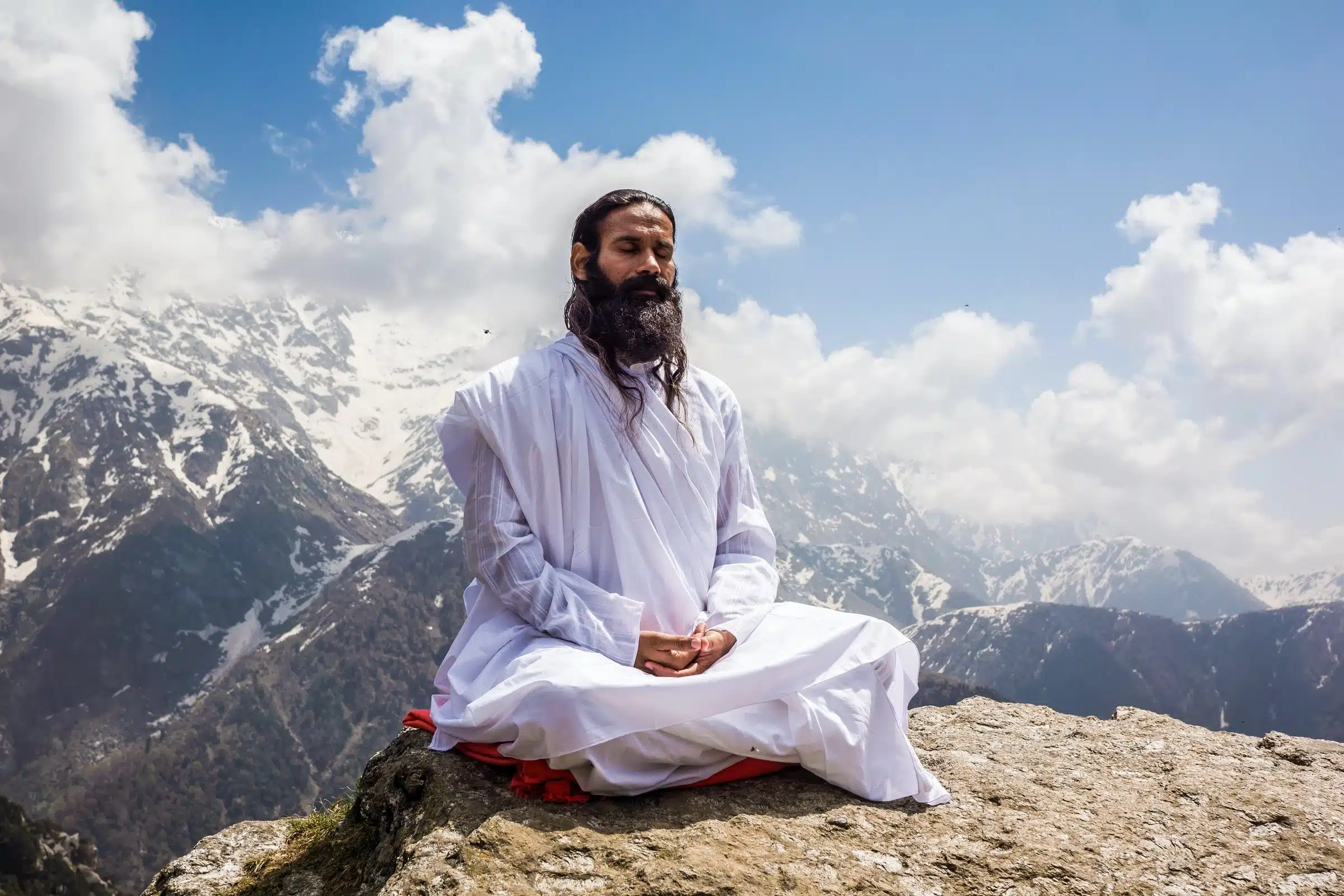
Yoga is a way to keep your mind and body in harmony. It’s like an art and science that helps you live a healthy life. Yoga comes from the Sanskrit word ‘Yuj,’ and it means ‘to join’ or ‘to unite.’ According to yoga teachings, practicing yoga helps connect your individual consciousness with the Universal Consciousness, creating a perfect balance between your mind and body, and between you and nature.
Modern scientists say that everything in the universe is part of the same quantum stuff. When you feel connected to everything around you, you’re said to be in yoga, and you’re called a yogi.tun It means you’ve reached a state of freedom called mukti, nirvana, or moksha. The goal of yoga is to realise your true self, overcome suffering, and achieve a state of liberation or freedom.
Yoga is like an inner science that offers different methods for people to experience this connection and take control of their lives. It’s considered an important part of the ancient Indus Saraswati Valley civilisation, going back to 2700 B.C. Yoga has shown itself to be beneficial for both physical and spiritual well-being. The core values of yoga practice are about being a good and kind person.
Yoga has existed since the dawn of civilization. It’s an ancient practice that started thousands of years ago, even before the first religions were established. According to yogic stories, Shiva is seen as the very first yogi and guru. He shared his deep knowledge with seven sages near a Himalayan lake called Kantisarovar several thousand years ago.
These sages, known as the Saptarishis, then spread the wisdom of yoga to different parts of the world, including Asia, the Middle East, Northern Africa, and South America. Interestingly, scholars today notice similarities in ancient cultures worldwide. However, India is where yoga truly flourished. A sage named Agastya, who journeyed across the Indian subcontinent, played a key role in shaping a culture centered around the yogic way of life.
The evidence of yoga in ancient India is not only seen through seals and fossil remains from the Indus Saraswati Valley civilization but also in the diverse cultural and religious traditions that have roots in that period. The depictions of Yogic motives and figures engaged in Yoga Sadhana on artifacts from the civilization suggest a deep connection between the people of that time and yogic practices. The presence of phallic symbols and seals of idols of the mother Goddess in this ancient civilization also hints at the existence of Tantra Yoga, showcasing the diverse range of yogic traditions.
The Vedas are a treasure map, whispering secrets of self-realisation across millennia. Within their verses lie not just abstract concepts, but potent tools for harnessing the energies (prana) that flow through us, aligning with the cosmic dance of creation (Brahman), and ultimately uniting the individual self with its divine source. And then there’s Yoga, the skilled artisan who takes this map and builds a bridge, brick by conscious breath and sculpted asana, to reach that hidden treasure. It’s not just about acquiring knowledge; it’s about embodying it, yoking the body and mind to become conduits for the divine wisdom hidden within the Vedas. So, as you delve into the ancient verses, remember, Yoga isn’t merely a practice; it’s the key that unlocks the hidden chamber of self-realisation enshrined within the Vedas. What insights await you when you walk this path with both map and compass in hand?
Imagine yourself not scaling a majestic mountain, but traversing an intricate ant’s path, painstakingly crafted by the wisdom of the Upaniṣads. This is the Yoga journey described in texts like the Varahopanishad, a slow, persistent crawl towards uniting the jivatman, the individual soul, with the vastness of the paramatman, the universal self. While other Upaniṣads like the Chandogya and Isha focus on meditation and ethical living, the Yoga Upaniṣads delved deeper into specific practices for harnessing prana, awakening nadis, and refining the mind. This diversity isn’t just theoretical; it reflects the multifaceted nature of Yoga, offering a unique path for each seeker.
The blossoming of Samkhya realism during this period added another layer to the tapestry of Yoga. The emphasis on distinct realities – consciousness (purusha) and matter (prakriti) – led to a deeper understanding of the “yoking” at the heart of Yoga. It wasn’t just about merging two identical entities; it was about aligning the finite with the infinite, the material with the divine.
Yet, what truly sets Yoga apart is its promise of accelerated growth. Unlike natural processes that unfold over eons, Yoga equips us with the tools – discernment, focus, and conscious effort – to actively shape our inner landscape. We become sculptors of our own spiritual evolution, not passively waiting for time to pass.
The Upanisadic vision of Yoga isn’t a mere philosophy; it’s a burning invitation. It whispers that within each of us lies the potential to transcend limitations, dissolve dualities, and experience the profound unity of the jivatman and the paramatman. So, step onto the ant’s path, embrace the deliberate discipline of Yoga, and embark on your own transformative journey of self-realisation.
Picture Yoga as a multi-faceted diamond, each facet reflecting a different dimension of this transformative practice. The Gita’s first definition unveils Yoga as a “dis-union with grief,” not a mere escape from suffering, but a liberation from the egoic limitations that amplify it. It’s like shedding a heavy cloak of self-centeredness and stepping into the light of inner peace.
Next, we encounter “skill in action,” not just technical proficiency, but action fuelled by the fire of mindfulness and detachment. It’s the dance of a Karma Yogi, who weaves a tapestry of selfless service, unattached to applause or criticism. This isn’t mere efficiency; it’s a path of spiritual evolution through action.
Finally, there’s “equanimity,” not emotional apathy, but a steady inner compass that remains unruffled by life’s storms. It’s the unwavering peace of a tree rooted in a deep connection to something beyond the shifting sands of circumstances. These facets aren’t isolated; they interweave, forming a symphony of self-realisation.
Perhaps within these definitions lies a blueprint for your own transformative journey. Will you step onto the path of “dis-union with grief,” embrace the skilful dance of Karma Yoga, and cultivate the unwavering harmony of equanimity? The Bhagavad Gita whispers an invitation, and Yoga waits to unfold its multifaceted magic in your life.
If your mind is a turbulent ocean, whipped by storms of desire, fear, and attachment. The Yoga Vasishta offers a raft, not just for calming the waves, but for steering towards the sunlit shore of self-realisation. It reveals that our worldly sorrows are not external afflictions, but ripples born from our own distorted perceptions of reality. Vasistha Maharshi, with his gentle wisdom, invites us to see through these illusions, not through harsh denial, but through a compassionate exploration of our inner landscape.
His tools are not magical spells, but practices like self-inquiry, meditation, and a shift in perspective. He asks us to contemplate the ephemeral nature of desires, the illusory separateness of our egos, and the underlying unity that binds all things. Through this lens, fear melts away, anger dissipates, and envy withers, revealing the radiant heart of our true Self.
This union, the merging of Jivatma and Paramatma, isn’t some distant goal, but a potential that blossoms within each of us. It’s not about escaping the world, but living in it with awakened eyes, experiencing every moment with a profound sense of peace and connection. So, let the whispers of the Yoga Vasishta guide you on your voyage inward, for within its pages lies a map to navigate the turbulent waters of the mind and discover the boundless ocean of your true Self.
The seeds of Yoga, sown in ancient philosophy and spirituality, blossomed into a vibrant tapestry of schools during the traditional period. Samkhya and Yoga danced together, exploring the interplay of consciousness and matter through meditation. Buddhism resonated with the practice of mindfulness, seeking liberation from suffering through mindful awareness. Hinduism’s tapestry weaved devotional Bhakti Yoga with the philosophical inquiries of Advaita Vedanta, leading to paths of union with the divine. This vibrant landscape saw philosophies cross-pollinate, practices evolve, and new lineages emerge like the powerful wave of Tantra, emphasising energy and ritual. And it’s this rich legacy that continues to nourish contemporary Yoga, offering diverse paths for self-discovery and inner transformation.
While classical Yoga emphasises postures and breathwork, the wisdom of Buddha offers a complementary path to self-realisation through the eightfold path. This isn’t just a moral code, but a dynamic dance of mindfulness, ethical conduct, and mental discipline. Imagine weaving a tapestry of right view, intention, speech, and action, each thread strengthening the others, leading to a life grounded in compassion and wisdom. Unlike striving for perfect postures, the eightfold path invites us to cultivate “rightness” within, aligning our thoughts, words, and deeds with our deepest values. It’s a journey that starts with mindfulness, like a candle flame illuminating the path within, guiding us towards liberation from suffering and the joyful blossoming of our true nature. Perhaps, within the tapestry of your own life, you’ll find threads of the eightfold path waiting to be woven, leading you on a transformative journey towards inner peace and awakening.
Forget intricate postures; for Jainism, Yoga is a dance of the soul, a journey inwards through Dhyana and Samadhi. Yet, this journey isn’t paved solely with meditation; it’s illuminated by the three jewels of right view, right knowledge, and right conduct. Jain Yogas�?dhan�? transcends theistic frameworks, reminding us that the key to liberation lies within. It’s about scrubbing the mirror of the mind with the gentle cloth of Ahimsa, non-attachment, and compassionate action. Each mindful step, each kind word, and each act of generosity becomes a brushstroke on the canvas of our being, leading us closer to moksha. The path may be demanding, but the reward is a heart overflowing with peace, a mind radiating wisdom, and a life woven with the golden thread of ethical awareness. Perhaps, nestled within the folds of your own curiosity, lies the thread of Jain Yogasdd?, waiting to be unravelled, leading you on a journey of self-transformation and a world touched by the gentle light of non-violence and compassion.
Sikhi Moksha isn’t about dissolving into a formless void; it’s about tuning the instrument of your soul to resonate with the cosmic symphony of the Divine. It’s not a passive wait, but an active dance of surrender and service. Imagine polishing a mirror until it reflects the boundless sky; with unwavering faith and righteous action, the Sikh’s heart becomes that mirror, reflecting the Divine Light within and without. Guru Nanak’s message echoes the spark of the Divine in every blade of grass, every beating heart, and treat all beings with the reverence due to a reflection of the One. In living generously, chanting the Naam, and facing challenges with Chardi Kala, the Sikh weaves a tapestry of devotion, not to escape the world, but to transform it into a living expression of the Divine Will. Perhaps, within the melody of your aspirations, lies a note in tune with the Sikh path, waiting to be sung, leading you on a journey of service, devotion, and radiant alignment with the Divine Source.
Kundalini Yoga isn’t just about stretching and chanting; it’s a daring dive into the depths of our own potential. Imagine a slumbering serpent of energy coiled at the base of your spine, holding the spark of your full, awakened self. Kundalini Yoga, drawing from the wisdom of Shaktism and Tantra, offers the key to awaken this energy, not with brute force, but with a symphony of practices. Pranayama fans the flames of awareness, Kriya Yoga channels the flow, Mudras sculpt the energy, and Bhakti Yoga pours devotion like fuel. This isn’t a journey for the faint of heart; Kundalini’s awakening can be intense, bringing to light shadows and releasing pent-up energies. But in the embrace of a qualified teacher and with dedicated practice, the rewards are boundless. Deep healing blossoms, creativity soars, and a profound connection to oneself and the divine becomes a lived reality. Perhaps, within the whispers of your own curiosity, lies the echo of the Kundalini’s call, inviting you to embark on a transformative journey into the depths of your being.
The Middle Ages witnessed a bloom in Yoga’s tapestry, with Hatha Yoga taking centre stage. It wasn’t a mere fitness craze; it was a laboratory of internal alchemy, where asanas danced with pranayama and mudras became tools to sculpt the subtle body. Texts like Hatha Yoga Pradipika and Gheranda Samhita whispered secrets of prana’s flow and nadi’s awakening, weaving physical practices with ancient wisdom. This wasn’t a rejection of tradition but an expansion of its canvas. The body, once seen as just a vessel, became a temple to be refined, a stepping stone to higher consciousness. Mental clarity and physical well-being weren’t mere side effects; they were stepping stones on the path of liberation. This shift laid the foundation for Yoga’s global journey, offering everyone, regardless of belief, a potent cocktail of physical fitness and spiritual exploration. Perhaps, within the folds of your curiosity, lies a thread waiting to be woven into the vibrant tapestry of Hatha Yoga, inviting you to sculpt not just your physique, but your inner landscape as well.
Swami Vivekananda was a revolutionary who saw Yoga as a potent tool for social transformation. He envisioned a world where the principles of Karma, Bhakti, Raja, and Jnana Yoga weren’t mere philosophies, but catalysts for collective progress. With scientific precision, he deconstructed ancient practices, revealing their practical benefits for the body and mind. Each inhale in Pranayama became a measured experiment, each asana a meticulously tuned instrument for unlocking human potential. This wasn’t merely self-improvement; it was a ripple effect, empowering individuals to become agents of positive change. Vivekananda’s call for selfless service ignited communities, his devotion to universal values bridged cultural divides, and his embrace of scientific inquiry paved the way for Yoga’s global journey.
Swami Sivananda Saraswati wasn’t just a doctor who embraced Yoga; he was a visionary who saw the four Yogas as threads in a tapestry of self-realisation. In his hands, Karma Yoga’s selfless service wasn’t merely a distant ideal, but the fuel that ignited the mind for Bhakti’s devotion. Raja Yoga’s discipline became the chisel that sculpted the body for Asana’s physical refinement, and Jnana Yoga’s wisdom illuminated the path for all. His teachings weren’t confined to ancient texts; they danced in the streets through social service, flowed in the air with conscious breathing, and bloomed on the plate with mindful eating. Sivananda’s Yoga of Synthesis wasn’t just about perfecting an asana; it was about perfecting oneself, offering a practical roadmap for holistic well-being.
Paramahansa Yogananda was a mapmaker who unveiled the hidden pathways within. His tool of choice? The potent practice of Kriya Yoga, a symphony of breath, energy, and awareness designed to awaken the slumbering giant within – the prana. Unlike esoteric secrets whispered in hushed tones, Yogananda democratised this transformative practice, offering a key to unlock the door to self-realisation for anyone willing to explore. Through his captivating words in “Autobiography of a Yogi” and his global teachings, he sowed the seeds of Kriya Yoga across continents, influencing the very landscape of modern Yoga. This wasn’t just about perfecting an asana; it was about diving into the depths of your being, experiencing the unfiltered truth of your soul.
B.K.S. Iyengar, or Bellur Krishnamachar Sundararaja Iyengar, made a significant contribution to modern yoga. He played a crucial role in popularising and spreading the practice of yoga globally, making it accessible to people of all ages and abilities. Iyengar developed a unique style of yoga, now known as Iyengar Yoga, which focuses on precision, alignment, and the use of props to help practitioners achieve the correct postures. His emphasis on detail and alignment has had a profound impact on the way yoga is taught and practiced today. Iyengar’s teachings go beyond physical postures; he emphasised the integration of body, mind, and spirit in the practice of yoga. His approach has been instrumental in making yoga more therapeutic and adaptable, allowing individuals with various physical conditions to benefit from its practice. B.K.S. Iyengar’s numerous writings, including his seminal work “Light on Yoga,” have become essential references for yoga practitioners and instructors. His dedication to spreading the transformative power of yoga has left a lasting legacy, influencing the modern understanding and practice of this ancient discipline.
Yoga is like a colourful quilt made from both ancient wisdom and new ideas. Think of traditional poses combined with modern knowledge about how our bodies work, and breathing exercises mixed with today’s mindfulness techniques. It’s not a random mix; instead, it all works together to make Yoga useful for dealing with the challenges of modern life. This diverse quilt provides tools for managing stress and building emotional strength in the 21st century. Yoga isn’t just for one place; it’s a worldwide conversation. Different cultures add their own ideas, creating a lively and inclusive quilt.
Understanding yoga’s origins fosters a deeper appreciation for its vast legacy. This ancient tradition continues to evolve, offering a timeless path for personal growth and well-being in our ever-changing world.
Yoga was not invented by a single person but evolved over thousands of years. The earliest mentions are found in the Rig Veda, ancient sacred texts of India.
Yoga’s origins can be traced back to ancient India, evolving organically over millennia.
There’s no single founder. Yoga’s rich heritage was shaped by countless teachers, philosophers, and practitioners who contributed to its evolution.
Yoga originated in India. Its practices and philosophies are deeply rooted in Indian culture and spiritual traditions.
Yoga and Hinduism are deeply intertwined. The Vedas, Hinduism’s foundational texts, mention yogic practices. Over time, yoga philosophy and practices permeated various aspects of Hindu life and spirituality.
Please login with social account to support this post.